Sunday, April 25, 2010

When College and Pro Alliances Collide...How Sweet It Is

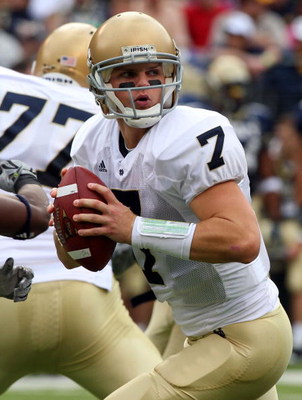
It's not too often that your favorite pro team uses a high draft pick on one of your favorite players from your favorite college team. It's something that I wasn't sure I'd ever see. Other than a brief, albeit successful, flirtation with Rocket Ismail in the latter stages of his NFL career, my team had never had a notable Notre Dame player on roster. I didn't expect that to change last weekend during the NFL draft. Every indication was that Carolina was going to select either a possession wideout or a defensive player with their first pick in the 2010 draft, neither of which portended an Irish player.

Watching the draft, I was much more concerned with where two of my all-time favorite college players, Jimmy Clausen and Golden Tate, were headed than I was with Carolina's pick. I'm rarely enthralled with the Panthers' early picks - DeAngelo Williams in 2006 excepted - although often I turn out to be wrong.

The most shining examples of this wrongness came in 2005 and 2008, when I wanted different players at the same position as the Panthers drafted in round 1. In '05, I was smitten with Derrick Johnson and was thoroughly bummed when Carolina selected fellow linebacker Thomas Davis one pick before Johnson. In '08, I wanted Rashard Mendenhall instead of our pick, Jonathan Stewart. As of now, Davis is a Pro Bowler and Stewart is part of one of only four double-1,100 yard rush tandems in NFL history, while Johnson has been virtually nonexistent and Mendenhall has been good, but not as good as Stewart. Since then I've generally trusted the front office's judgment.

Anyway, it didn't even occur to me, even when Clausen slipped out of the first round mostly due to the fact that he wore a gold helmet in college, that the two rooting interests would intersect. I had good reason not to suspect this.

For one thing, entering this year, Carolina had not selected a quarterback before the FOURTH round of the draft since their first-ever draft pick of Kerry Collins back in 1995. (Impossible for me to believe, but true.)

For another, coach John Fox and general manager Marty Hurney are in the last years of their contract, and both would probably have been fired three months ago if not for the looming lockout, and our owner's reluctance to potentially be paying two different coaches and GMs during it. With that factor in play, selecting a rookie quarterback, pretty much the only position where the media will freak out on you if you dare to play a rookie, seemed impossible.

I could write a whole article about how asinine it was that Jimmy Clausen, the most accurate quarterback I've ever witnessed play (that's college OR pro, and yes, I'm going there) was still available at 48 when Sam "My Throwing Shoulder Is Held Together by Spellotape" Bradford is going to get $50 million guaranteed and the Denver Broncos traded half their draft to select Tim "I've Never Used My Current Throwing Motion in a Game" Tebow. But luckily for me, I don't have to, because the very, very fine folks at WalterFootball.com wrote one for me. It was written pre-draft, but it's still a very enlightening read.

Back on topic. I was so certain that Clausen would not be taken when pick 48 rolled around and he was still there that I posted a Facebook comment on a friend's "Carolina will get a QB" status stating, basically, that I'd love to be wrong, but I didn't see any way we were going to do it.

About a minute later, I received a Tweet on my feed that I will never forget. It came from ESPN's Chris Mortensen, who had been among the handful of people occasionally Tweeting draft picks, or at least predictions, before they were made. The Tweet read simply, "Clausen to panthers #nfldraft".

I had to read it like 3 times before I registered it. This could not be true. Clausen, the guy who I vehemently defended for the last 3 years? Clausen, who both Mel Kiper Jr. and myself had both basically stated that if Clausen couldn't succeed in the pros, no quarterback could? Clausen, a QUARTERBACK?

Sure enough, NFL commissioner Roger Goodell emerged a couple of minutes later and read the pick. It was Jimmy Clausen. My team, for the first time since Collins, had a legitimate franchise quarterback.

I'm pretty sure I blacked out. When we picked Williams in 2006, I ran around my dorm room pumping my fist. When we picked Clausen, I'm not quite sure what I did. I think I got up and did a little dance. I'm not even sure. I do know that I sent my mom, a die-hard ND fan whom I was updating on the proceedings, an all-caps text with the news. I then fielded at least 4 Facebook wall posts congratulating me, as well as a call from my best friend, Mark, congratulating me as well.

Let me tell you what this means. This is a game-changer for the Panthers' franchise. Up until now, I wasn't sure where Carolina was headed. They had spent the off-season slashing costs by cutting highly-compensated veterans. Our entire QB corps has a total of 8 starts (all by Matt Moore) among them. We had some building blocks - a good offensive line and secondary, and of course Williams and Stewart - but nothing indicated that this was going to get put together this year.

Well, it still probably isn't getting put together this year. After all, I'm the biggest Jimmy Clausen fan without a blood relationship on the planet, but even Peyton Manning was pretty bad his rookie year. (Then again, Manning didn't have the benefit of said offensive line and running backs.) But the future of this franchise is set. And Jimmy Clausen is the man to guide it. Coach Fox was quick to inform Clausen that Carolina's offense is all but a carbon copy of the offense he ran under Charlie Weis at Notre Dame - no surprise, since Jeff Davidson, the offensive coordinator, is a Weis disciple.

So by the end of 2010, expect the Jimmy Clausen era to begin at Carolina.

I still have to pinch myself that I get to write that sentence.

Go Irish. Go Panthers. Go Clausen.

Wednesday, March 24, 2010

A Bracket in Tatters

Luckily, my bracket is not among those in tatters after Northern Iowa shocked Kansas, the tournament favorite (roughly 40 percent of ESPN.com users picked the Jayhawks to win it all). I had much more trouble picking the Midwest Region than any other bracket, struggling with my pick of Ohio State-Georgetown (that one was taken care of for me) and Ohio State-Kansas.

For no discernible reason I went with the Buckeyes, a pick that looks prescient now that OSU seems to have a sweetheart draw to the Final Four (a Jekyll-and-Hyde Tennessee team, followed by either UNI or a depleted Michigan State squad). I ended up with OSU as champion, and I was outspoken in my belief that the winner of that presumed Kansas-Ohio State matchup would win the title. Now that matchup won't happen.

A portion of my bracket that's not so hot? The South, of course.

The most befuddling region in the tournament due to Duke's placement as a #1 seed and the seedings that appear to have been determined via drunken darts, the South proved my downfall. The total number of games I will get right in that region, out of 15? The answer is 5.

Duke, Villanova, Baylor, Texas A&M and St. Mary's. I picked those 5 teams to win in round 1. I missed EVERY OTHER GAME in the region. This was due in equal parts to my catastrophic pick of Louisville to the Sweet 16 (bet on Good Louisville showing up and instead got When's-Tip-Again? Louisville), Notre Dame to the Sweet 16 (complete homer pick, should have known better) and Villanova to the Final Four (I would've had them out in round 2 in almost any other draw). I also bet on Purdue to go out to Siena - something I should have known wouldn't happen because I wanted it to. Generally, my least-favorite team in the tournament does spectacularly well, whether it's UNC (almost always), or this year, Purdue. All bets are off with them, and frankly the more I root against them, the better their chances get.

Still, I stand in decent shape. Both of my title game participants are intact, something only 6 of the other 17 people in my bracket pool can claim. (Half our pool - 9 people - had Kansas to win the whole thing.) Only one of my Final Four - Villanova - has been dispatched. Only one person in our pool has an intact Final Four, and his Final Four includes Butler, so that will last about 1 more day.

But brackets aside, the first weekend, as has been beaten to death by the national pundits, was spectacular. Game after game seemed to come down to the wire. Friday was a relative clunker, but the other 3 days of the Dance proved to be unreal. The only regret was that neither Gus Johnson (marooned in Buffalo, where no game came down to the final minute) nor Bill Raftery (in Providence where Nova/Robert Morris proved to be the only great game) were there for the most exciting shots: Farokhmanesh, Lucious, and Danero.

I'm of the opinion that Ali Farokhmanesh's shot should be revered perhaps above all the others. Farokhmanesh's chuck (I predict the shot gets remembered simply as his last name, with no other description needed) defined what the tournament is all about - underdogs playing to win, playing as if they have nothing to lose. As one sportswriter (Pat Forde or Seth Davis, can't remember which) said, Farokhmanesh wasn't in a 'nothing to lose' situation. Most great tournament shots were made by people for whom a miss wouldn't have been blamed on them, given the circumstance. After all, no one ever blames a loss on a last-second miss (unless it's a layup or something). But Farokhmanesh was in a spot where the 'on paper' play is to run more clock. If he missed, and UNI lost, it would've been on him. But he saw an opportunity for greatness, and he took it. Really inspiring stuff. I'll never forget "the Farokhmanesh", just like I'll never forget Murray and Michigan State's buzzer-beating wins. Great stuff. One can only hope Cornell, UNI and St. Mary's can carry the mid-major banner even further.

Monday, March 15, 2010

Selection Sunday: The Good (6 Seed?) and the Bad (Quinn Dumped for Two Footballs and a Helmet)


For Notre Dame fans, as with many fans, the good often comes with the bad. And of course, because they're Notre Dame, it's usually magnified in both cases.

Selection Sunday was slightly different, because the good involved the Irish hoops team, which has been much less polarizing than the football team due mostly to its lack of historical success and its conference membership. The bad - Brady Quinn's trade, which may or may not signal the death knell for his starting hopes - was played down somewhat due to its proximity to Selection Sunday.

But for me, they were the top stories of the day.

Notre Dame's seeding was truly shocking. After ND's run to end the year (see prior post), I was thinking ND was headed for a 10 or 11 seed, with some thinking the Irish needed to win a Big East tournament game to even make the field. The Irish cruised by Seton Hall to end that discussion, upset Pitt in the quarterfinals, then took West Virginia to the wire in the Big East semifinals to place themselves firmly into the field. The apparent bad news was that ND had played themselves squarely into position for the 8/9 game. A clear majority of bracketologists placed the Irish on the 8 seed line - and with Syracuse a presumptive 1 seed, that left, for most, a 2/3 chance that ND would be matched up with Kansas or Kentucky, the 2 teams I fear most, in round 2. Some people had WVU as a 1 seed (something I endorsed and believed should happen) which meant Notre Dame would've had to play KU or UK in the 2nd round.

After a lot of talk and a lot of deliberation (my own message board did a mock selection committee of a small group of people that would end up getting 64 teams correct and placing 61 of those within one seed line, much better than most of the major bracketologists, for what that's worth), the selection show was on. I, as I do every time ND makes it, sat at rapt attention to see where the Irish would end up.

And quickly, something weird became clear. The first bracket was revealed, the Midwest region. And only one Big East team - Georgetown - was in it. To this point, the committee had never placed more than two league teams in the same region (avoiding a potential conference game before the Elite 8), so alarm bells quickly began going off. I realized this after the 2nd bracket was revealed - only 3 league teams had been shown so far. This meant one thing to me: Someone got left out. Louisville, who had been mentioned in passing as a bubble team, was first in my mind, but...could it be?

After all, this is the same selection committee that placed a 14-4 Big East team on the 5 seed line. The year before, that selection committee underseeded Notre Dame to 6, THEN dramatically underseeded tournament darling Winthrop to ensure they faced the Irish in round 1. Could ND have somehow been left out?

To make a long story short, no. It turned out the goofs on the committee placed 3 Big East teams in the South bracket - one of whom was Notre Dame. The Irish, the last matchup revealed, were shown as a 6 seed against Old Dominion.

Now, Old Dominion is a good team, probably underseeded, so Notre Dame is effectively getting a 7, but still. Baylor seems pretty good for a 2nd round matchup compared to the 2 seeds ND could have drawn (KSU, Ohio St) or Kansas or Kentucky if it'd been a 1. The seeding of ND has been panned by most, although many have bigger complaints about the bracket (Cal as an 8 and Duke's ridiculous path to Indy among them). Three weeks ago, ND was 6-8 in the Big East, so a 6 seed is absolutely mind-blowing considering the big picture. I have high hopes. My bracket places ND in the Sweet 16, but I think ND could go anywhere from home Thursday afternoon to the Final Four. They're unpredictable, and so is the South region.

The bad thing? Oh, the Quinn trade.

You know my opinion of Quinn. I'm a blue and gold bleeder and always* will be, and I feel like he got the screw job in Cleveland.

(*I will - WILL - bail if the Irish join a conference, unless they truly are forced to by the creation of superconferences. If they join when no real change occurs, I will bail because the leadership will have hoodwinked us into it with their hideous scheduling. Anyway, that's neither here nor there.)

The Browns married themselves to a bad QB who had a fluky season and didn't let Quinn play until halfway through year 2. A broken thumb submarined a really bright start to Quinn's career, then the Browns fired their coach. The guy they brought in, Eric Mangini, is a grade-A d-bag (no one argues this). He didn't give Quinn any confidence whatsoever, and when Quinn floundered early on a team that had jettisoned all their talent against good defenses, he was unfairly benched at halftime of game 3 for Anderson. Quinn was then left on the bench as Anderson continued to suck, and it was clear as day that the Browns were keeping him there simply to keep Quinn's contract escalators from kicking in. Then, when he returned, Quinn showed a bit (a fantastic performance against the Lions) but mostly struggled again - on a talentless team. He would later get hurt again to end his season.

The Mike Holmgren era began as GM and Holmgren was noncommittal on his QB situation. We now know it was because he disliked both - he cut Anderson and shipped Quinn off for two third-day draft picks and a backup RB. Quite a haul for a guy you burned a first-round pick on, and gave 12 starts to before pitching him.

The trade, particularly the nothing that Denver surrendered for him, makes me think Quinn may be done as a starting QB - something that would be among the bigger injustices in the history of young NFL quarterbacks, in my opinion. (And Cleveland is now rumored to be after Jimmy Clausen - if that happens I'll start to wonder if the league has it out for ND quarterbacks, because Clausen, though more talented than Quinn, will flounder just the same way if presented with that mess.)

Kyle Orton is a beat-out-able quarterback, but he did little last year to lose his job. Quinn will now be working with a Weis disciple (Josh McDaniels succeeded him as Patriots' offensive coordinator), but Romeo Crennel worked with Weis too and that didn't seem to be enough to give Quinn a look for quite a while. We shall see, but my hopes aren't high. It's a sad saga for my all-time favorite college football player (for personal reasons more so than on-field reasons).

Either way, it was an eventful Sunday for Notre Dame.

Sunday, March 7, 2010

Carleton Scott Explodes, Luke Harangody Watches, and Notre Dame Defines the Ewing Theory

In my sports fan life, the list of miraculous in-season turnarounds I've been privileged enough to witness as a fan of the team involved is incredibly short.

The 2004-05 Chicago Bulls started 0-9 before finishing the year winning 45 of their last 73 games, making the playoffs for the first time in 7 years.

The 2007 Chicago Cubs were as many as 8.5 games behind Milwaukee in late June before a 5-run comeback, capped by a walk-off Aramis Ramirez home run, propelled the team to the best 15-month stretch I've ever had in my sports-fan life, as the team ripped off the best record in baseball the rest of that season to win the division and the best record in baseball the following season to win another division. Typical of the Cubs (and for that matter all of my teams in important games), they failed to win a playoff game either time, but that's not the point.

Well, add the 2009-10 Notre Dame Fighting Irish to that list. And, incredibly, it all began with their best player (and one of their top 5 players ever) being injured - proving, again, the Ewing Theory perfected by Bill Simmons reader Dave Cirilli. This theory follows around players whose teams 'inexplicably' play better when they are injured or unavailable - but there are usually good reasons why. In Harangody's case, the injury forced Carleton Scott into the lineup full-time, forced Jack Cooley into Scott's spot as the 7th guy in the rotation, and made ND more athletic, bigger and better on defense. In addition, Mike Brey decided to go Princeton on us, slowing down ND's pace rather than trying to outrun people. It's a move that coach Mike Brey claims was in the works prior to Gody's injury, but because of the injury made ND a team that had more energy at the end of games.

It started with the Irish at 6-5 in the Big East going into the Seton Hall game. To that point, ND had been relatively disappointing, showing flashes of brilliance (an incredible 1st half that propelled them to a key win over West Virginia early in Big East season, for instance), but for the most part seemed, just like the 08-09 model, to be playing below their talent level. Stupid losses to Cincinnati (horrible FT shooting by a usually-good free throw shooting team) and Rutgers (RUTGERS?) had ND fans scratching their heads and wondering if it was OK to call for Mike Brey's ouster just two years after a 14-4 Big East season.

Naturally (because bad things just happen to the Irish hoopsters without explanation), Jeremy Hazell chose that game to shoot out his ass, making at least four wild off-balance three-pointers and scoring, I believe, 35 points on 20 shot attempts or something insane. The Pirates not only won, but their arena was the site of Luke Harangody's deep knee bone bruise when he landed wrong attempting to get a rebound. The injury would keep him out the next five games.

It looked like ND was screwed regarding its latent NCAA hopes. Even more so when the team managed to lose at home to St. John's, thanks to a horrid game from Tory Jackson, to fall to 6-7 in the league. Without Luke, the five games that remained - @Louisville, Pittsburgh, @Georgetown, UConn, @Marquette - looked like a gauntlet. The team needed 4-1 to even consider a tournament bid, it appeared. And 1-4 (or 0-5) looked a hell of a lot more likely.

Instead, Notre Dame did something neither I nor any other close observers thought possible - they toughened up on defense, they slowed down their pace, and they didn't miss a beat whatsoever. In fact, the Irish got better. A lot better.

I confess to having skipped both the Louisville and Pittsburgh games. They conflicted with what I thought were more important Ball State home games. Both teams would go on to make me look silly for feeling that way, but anyway. Herewith, a game by game recap of the team that (appears to have) changed everything.

Game 1: ND loses to Louisville in double OT

ND went on to fight their butts off against Louisville, losing only because 1) Ben Hansbrough missed 4 free throws at the end of regulation and 2) Samardo Samuels was allowed way too much latitude, resulting in every ND big man fouling out of the game. (This info is gleaned from the ND board I frequent, so take it with whatever sodium substitute you choose.) So many Irish fouled out that we were left with four people who were no taller than 6'2" in the game towards the end of double OT. The game sadly ended when ND failed to get a shot off on their final possession, stepping out of bounds. At this point the Irish were 6-8 in the league and were essentially out of tournament consideration. Only sweeping their final four games would even broach the attention of the selection committee - ND's nonconference schedule, as it has always been the last few years, was too weak for ND to be considered at 9-9.

Game 2: ND blows out Pittsburgh at home

Again, I skipped this game. Although impressed by the Irish's gutty performance against Louisville, I prioritized Ball State's game against Eastern Michigan - Senior Night - above this one. Pitt came in as the hottest team in the league and I assumed a beatdown was forthcoming for my Irish.

Instead, the Irish blasted Pitt. The final was 68-53, but 15 was about as close as Pitt had come the entire second half. The Irish physically dominated Pitt (a sentence that I never thought I'd write about a basketball game). Four Irish scored in double figures, and ND outrebounded Pitt by nine. It was a command performance by Notre Dame, but for the time being, it seemed to serve as little else but a reminder that these Irish should have been a lot better than they were. After all, ND still had two road games left against top-notch Big East competition, and they had to this point won exactly once at an opposing team's venue.

Game 3: ND handles Georgetown in Washington, DC

Georgetown played the toughest schedule in the league this year, their RPI is in the top 15, and as a big, tough team, they are a matchup nightmare for Notre Dame, a team that makes a living out of being quicker and getting open shots. This would seem impossible for ND against a bigger team. Austin Freeman was sporadic and ineffective - we would later find out he had diabetes - but this seemed like a minor stumbling block.

Notre Dame shot 57 percent from the floor and blocked 7 shots. I sat for much of the game in a state of shock. This was a Notre Dame team that was unlike any team the Irish had turned in since I had begun following them at the turn of the century. Carleton Scott was, quite simply, the best player on the floor, scoring 21, blocking 3 shots, absorbing a blatant cheap shot from Greg Monroe of Georgetown, and playing beyond his experience level. ND had 12 offensive rebounds. Georgetown had 12 defensive rebounds. Ben Hansbrough fought off the only serious Hoya threat late in the game by canning a 3. Suddenly, Notre Dame had two winnable games left (in fans' eyes), and a tourney bid was, impossibly, in our sights.

Game 4: ND earns revenge on UConn

UConn can be described using the old adage 'million dollar talent, ten-cent heads'. UConn is a talented team. UConn plays like a "bunch of retards trying to hump a doorknob out there", to quote Patches O'Houlihan. UConn chucked 14 3's, many long after it became obvious it wasn't going to work (they only made three). ND, of course, was 3/15 themselves, but they fought their butts off. Although UConn was so much bigger than the Irish that ND couldn't have a rebounding advantage, the Irish managed to keep UConn's advantage to 1.

Carleton Scott, so much a non-factor early in the season that he actually quit the team for a time (he missed the WVU game), had another double-double, with 12 and 14. And Tory Jackson, quite possibly the most unappreciated player in Notre Dame history, had 22 points in his final home game. Jackson has led the Big East in assists 3 times in his 4 years in South Bend. He has received all-Big East mention zero times. How is this? You tell me.

Game 5: ND pulls off a heart-stopping win at Marquette


I must confess something: At no point in this game did I think Notre Dame was going to win. At no point whatsoever. I wasn't comfortable with the way the game was going, Lazar Hayward is a ninny who always seems to save his best performances for us, Luke Harangody was back (which against all odds was not something I was looking forward to, considering the last two weeks), and Maurice Acker, who transferred from Ball State, is precisely the kind of player who would haunt Notre Dame. Acker already had by randomly lighting us up for 11 points in the 2nd half of Marquette's Big East tourney win over ND in 2008 that probably knocked the Irish down a seed line (or two).

ND couldn't shoot - again - so they were reduced to scrapping - again. Gody played but a few minutes, scoring 5 points and generally trying not to mess up his new team's flow. (I have to say, I admire the way Gody has handled all of this. It would be easy for a guy like him to get selfish after 3 straight years of carrying ND on his back, but when it was announced this weekend that he will continue to come off the bench the rest of the year, he was more than happy to do it. He knows that he has a chance to reinvent his legacy somewhat here at ND, and helping the Irish to a Sweet 16 bid - even not as the focal point - would simply add to his legend. Gotta love him.)

Tim Abromaitis hasn't been able to shoot in weeks, but showing why I love him so much, he powered his way to 18 points anyway. Tyrone Nash quietly had 13 and 9. The Irish outrebounded a bigger, faster, more athletic Golden Eagles team by TWELVE. Still, I doubted, doubted and continued to doubt, right up until the last four seconds, where, with ND down three and Marquette unbelievably refusing to foul despite plenty of opportunities, this happened.

The Carleton Scott 3 might end up going right in there with the Aramis Ramirez walk-off homer in 2007 and the Ben Gordon running floater at the buzzer to beat the Knicks in 2005 as moments that changed everything for me as a fan for quite some time. I've watched the clip of Jack Nolan losing his mind at least 15 times and I will watch it at least 30 more. From that moment, I knew ND was going to win, and sure enough, they did.

ND's now 10-8 in the Big East and pretty much a shoo-in for the NCAA tournament, barring some very surprising occurrences in Championship Week. It's an in-season turnaround that defied all description. And for once, it happened to my team.

Go Irish, and watch out, you 6/7 seed types that may end up drawing Notre Dame in round 1.

Thursday, December 10, 2009

The Legacy of Clausen


The legacy of Jimmy Clausen is that of a missed opportunity in Notre Dame football history.

After all, he might well be the best quarterback ever to suit up in the Notre Dame blue and gold. And yet, he leaves without ever winning more games than he lost in a regular season.

Jimmy Clausen's brilliance has been well-documented. If the Heisman Trophy could be awarded in a vacuum, without paying attention to team records, Clausen would have a really good shot at winning it and would quite possibly be in New York City this weekend for the presentation. It sounds ridiculous because he plays for a 6-6 team, but the fact of the matter is, Jimmy was the best quarterback in America this year. It really wasn't particularly close.

Statistics can't tell the story of Clausen, but they're a start. 3,722 passing yards. 68 percent passing. 28 touchdowns. Four interceptions, two of which were tipped and the other two of which were catchable balls (if poor decisions). Stats, though, don't capture the fear of God that was put into any team when Jimmy had a chance to win the game. I can only imagine what USC fans probably felt like as Jimmy was dissecting the Trojans' defense on his team's final drive on October 17th, or the relief they probably felt after Duval Kamara slipped on his route to prevent Jimmy's perfect pass from hitting him between the numbers for a game-tying touchdown that may well have turned the tide of the Irish season.

That USC game did turn the tide of the Irish season - for the worse. Although ND escaped a mediocre BC team and clobbered a hideous Washington State team in the two weeks after that, the Irish were never the same. And it was because the shine was off Clausen. It wasn't his fault, but ND's failure to deliver a victory against SC at the end put a dent in Jimmy's aura of late-game invincibility that he couldn't undo.

If it weren't for his supporting cast failing at the end of all four November games, Clausen would probably have a 10-2 record and a BCS bid to show for his efforts, but he doesn't. Clausen won ND games they probably shouldn't have won against Michigan State, Purdue and Washington with three consecutive game-winning drives, all on a painful turf toe that he did his best to pretend wasn't there (the way he walked when not being chased by defenders gave him away). If his defense had a pulse, it would've been four, as Clausen engineered what should have been a game-winning drive at Michigan. For that matter, if his defense had a pulse, ND would probably be 12-0 - ND scored at least 21 points in all six losses this year.

November made things pretty bad for Jimmy. His offensive line was so pathetic late in the game against Navy that he ended up being sacked for a safety that locked up the game for the Middies. The following week against Pitt, Jimmy was chased around by the Pitt defense while attempting to lead his team back and ended up having the chance to win it being stolen away from him by a replay official who inexplicably ruled an incomplete pass that had been blown dead well before anyone from Pitt picked it up as a fumble - one in a long line of ridiculous replay decisions that have gone against ND in the Weis era. Against UConn, everyone but him seemingly screwed up, as two late-game fumbles by Michael Floyd and Armando Allen helped UConn to OT and ultimately to the win. And in the final insult, ND allowed Stanford to score the go-ahead TD because it was the only way to ensure a chance to win it with Clausen. Jimmy once again got betrayed by his O-line but got ND within striking distance before running out of time.

Clausen will probably be shredded by the media pundits for his team's poor performance, just like Brady Quinn was (and still is in Cleveland). They'll ignore that Clausen is one of the most insanely accurate passers to ever walk this earth - I swear that more of Jimmy's incompletions than not were the product of throwaways or receivers failing to make a play on a ball they needed to make. Ultimately, he'll probably get picked behind a quarterback he's obviously better than, like Quinn was, and he'll probably get pigeonholed by whatever team takes him and unfairly benched behind someone he's obviously better than, like Quinn was. And none of that will ever take away from my memories of him - just like with Quinn.

Wednesday, October 7, 2009

Why Notre Dame Still Matters


The haters want you to believe Notre Dame doesn't matter. Every year Notre Dame struggles, the haters race to anoint the Irish irrelevant.

"They don't matter," say the haters.

The haters are wrong.

The Irish may not be 'mattering' for the right reasons in the last decade, but they still matter.

Why else was it a huge story when Notre Dame axed coach Tyrone Willingham after three seasons because of poor performance and even worse recruiting? The haters came up with every racist excuse in the book to try and get on the Irish for the firing. Never mind that the 2007 season - when the players Willingham recruited (and didn't recruit) were the upperclassmen - was an exercise in futility, due mainly to the fact that the Irish were forced to play a talented but not-ready-to-play-these-games freshman and sophomore class almost exclusively. The haters don't care about that. The haters didn't care that Willingham didn't even bring the team's best running back (true freshman Darius Walker) on the trip to BYU for the 2004 season opener. ND lost, a humiliating performance. A week later, Walker ran for over 100 yards in about a quarter and a half when a desperate Willingham pulled him off the bench against Michigan. He led the Irish to an upset win.

That was the thing about Willingham. Even when he brought talented players in to ND, he didn't know how to handle them. Jeff Samardzija didn't catch a TD in his first two years at the school - under Ty. Brady Quinn, who only came to ND after Quinn's HS teammate Chinedum Ndukwe's father convinced Willingham to look at him while recruiting Ndukwe, was a 50 percent passer his first two years at ND. Walker saw the second-most carries, behind Ryan Grant, even though every Irish fan could plainly see Walker should be getting the bulk of the work. Walker went on to be one of the best backs in Irish history in '05 and '06.

When Washington axed Willingham halfway through his fourth season at U-Dub for hideously pathetic performance - the Huskies went 0-12 in his last season - there was almost no talk. No one dared call Washington racist. Because just like at ND, he basically ran the program into the ground with horrible recruiting and bad in-game decisions. It is a mark of Steve Sarkisian's skill as a coach that he has taken Willingham's players and beaten USC. Although the Huskies are 2-3, their losses are to LSU, Stanford and ND - the latter two on the road. All three are solid teams, and all three will probably play January bowl games this year.

Anyway, I could talk about Ty Willingham for hours. This article is not about him.

Why else does Notre Dame matter?

The Irish have essentially decided four Heisman Trophies this decade. Unfortunately, none have been ND players.

2002: Carson Palmer. Palmer shreds the Irish, then ranked top 10 under Willingham, to separate himself from the field (Brad Banks, Larry Johnson, Willis McGahee). If you ask me, just looking at the numbers, Banks or Johnson would've been better picks. But the media hype machine surrounding ND and its opponents carried the day.

2004: Matt Leinart. Leinart shreds the Irish in Willingham's last game as ND coach to separate himself from the field (Adrian Peterson, Jason White, Alex Smith, Reggie Bush). If you ask me, Peterson should have won, but he was a freshman, so he was basically ineligible. Once again, the voting distribution was small enough that one can assume that the media hype machine surrounding ND carried Leinart to a Heisman.

2005: Reggie Bush. Bush ripped ND to shreds in the biggest game of the regular season, USC's 34-31 escape at South Bend. Media pundits, once again, caught up in the ND hype machine, basically announce the Heisman decided. Vince Young and Matt Leinart never have a chance, and Brady Quinn, the best quarterback on the field in that ND/USC game, is eliminated for his defense's failings. Now, this season, Bush probably is the best player. One can make an argument for Young, but Bush was phenomenal. But is he good enough to justify the biggest voting differential from 1 to 2 in Heisman history?

2006: Troy Smith. Smith didn't play ND in 2006. But he did play the Irish in the Fiesta Bowl the year before and enjoyed a solid performance thanks to ND's pathetic defense. The hype machine began for Smith almost immediately. Because Ohio State didn't lose a game in 2006, Smith was given the Heisman by a ridiculous margen over Darren McFadden and Quinn. Smith, facing actual defensive pressure for the first time all season in the BCS title game Jan. 8th, submits one of the worst performances in the history of the quarterback position against Florida.

In addition, Notre Dame made JaMarcus Russell the No. 1 overall draft pick by allowing LSU receivers to get wide open against them in the Sugar Bowl following the 2006 season. Russell, despite doing nothing but chuck the ball deep for wide-open receivers the entire game, despite the fact that LSU's own fans wanted Russell benched for Matt Flynn at points in the '06 season, is made the No. 1 pick by the hype machine. Brady Quinn struggles against a real defense and free-falls to pick 22. Russell is currently one of the biggest train wrecks of a quarterback in the NFL. Quinn...well...let's not talk about it.

Notre Dame still matters. They're still on NBC for all their home games. They still get talked about, year in and year out, more than any other college program. Not one, but both of ESPN's studio analysts for college football coverage are essentially there to wage war about ND (May and Holtz). And when an ND signal-caller plays as well as Jimmy Clausen has this year, they are (albeit bedgrudgingly) placed in the thick of the Heisman race.

No, Notre Dame is not irrelevant. The day the Irish win a game and no one complains or whines about it except the opposing team, or the day ND loses and the only team fan base that's happy about it is the opposing team's - that's when they'll be irrelevant.

Don't hold your breath.

Friday, January 16, 2009

Late Night Last Night

Sorry about no post this morning. Didn't get back from my 'other' job until nearly 3 am.

In the meantime, how about Pete Carroll basically tossing Mark Sanchez under a Hummer at his jumping-to-the-pros presser? I'm reading a lot about it and I'm kind of surprised. Mr. Player's Coach turning on a player? Especially a QB when USC is absolutely loaded with them? There's got to be more to this story. Keep your eye on it...